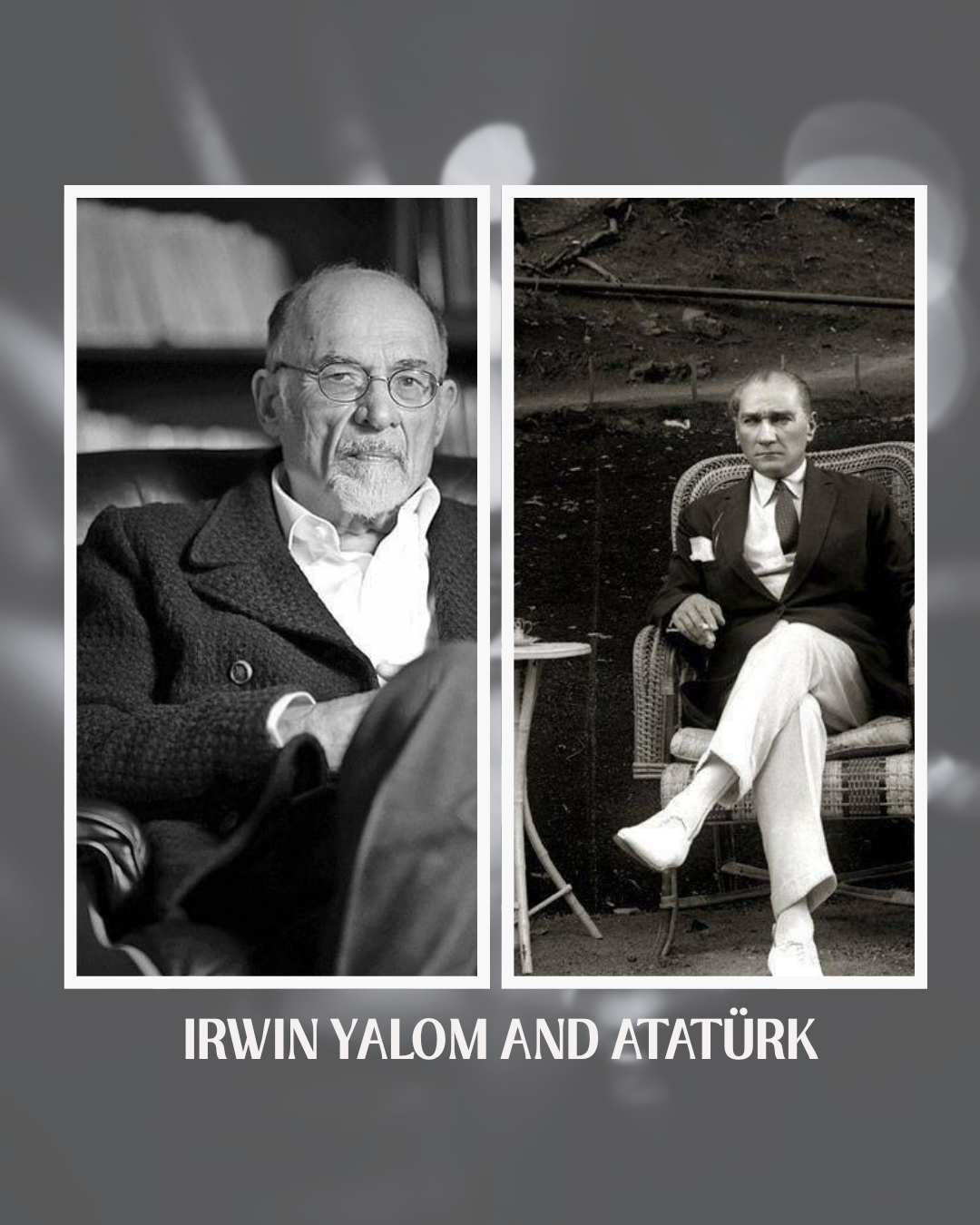
IRVIN YALOM AND ATATÜRK
WHAT DID THE COLLECTIVE UNCONSCIOUS TELL THEM?
We are living in an age of great urgency.
Time, one might say, is chasing us from behind.
The soul is trying to catch up with the body. When it does, it has a word or two to say; if only it
could get there in time. When it can't, the body makes itself ill in an attempt to find its natural
rhythm. That tempo we call "slowing down" becomes unreachable. In this era where everything;
emotions, news, even people; is consumed at speed, our minds move too fast to linger on what we
have lived through. Because almost no loss is properly mourned, we cannot make room for the new.
We feel perpetually exhausted, perpetually depleted. We seek our healing in post-modern
techniques, ideally somewhere fast and easy.
Perhaps our souls can no longer bear that arduous method so unpopular among clients and patients
who want a quick fix. Existential therapy; whose pioneers include Viktor Frankl, Irvin Yalom, Rollo
May and James Bugental; focuses on the individual's four primary anxieties: death, freedom,
isolation, and meaninglessness. The therapeutic process moves through these four core themes,
advancing through the client's lived experiences as they relate to their authentic self. Irvin Yalom
has managed to bring this deeply vital and demanding therapeutic approach to a literary language,
placing it on the agenda of psychology enthusiasts through books written around his own cases.
In this piece, we will take a broad look at the birth chart of Existential Psychiatrist Prof. Irvin
Yalom; author of Creatures of a Day, When Nietzsche Wept, Momma and the Meaning of Life, Lying
on the Couch, Treating Anxiety Disorders, Treating School-age Children, Inpatient Group
Psychotherapy, and many other works. A Jewish-American psychiatrist, he retired from Stanford
University, and has distinguished himself in the field through both individual and group therapy.
I would like to begin with what first caught my attention in his birth chart: his shadow sign; the sign
with the least planetary placements in the chart, and whose qualities therefore operate in a recessive
way; is Cancer. Because it is his shadow sign, the characteristics associated with Cancer need to be
brought to light in Yalom's life and, in a sense, made peace with. Among these we can count family,
roots, feminine energy, motherhood, attachments, and foundational emotions. It is surely no
coincidence that, driven even by the unconscious need to illuminate these shadow aspects, Yalom
eventually specialized in group therapy; which carries the feeling of a family within it. In his root
family story, we see migration to America from somewhere near Poland in the aftermath of World
War I. Cancer means roots and family dynamics; he belongs to the Jupiter in Cancer and Pluto in
Cancer generation. Through each of his patients, he has undoubtedly shed light on his own roots,
his own sense of isolation and meaninglessness, and his own existence.
What sets Yalom apart is his ability to chart a path for his patients through the labyrinth of
existential inquiry, and to convey the journey of therapy to his readers through clear, grounded,
results-oriented findings. The fact that he occupies a position capable of making even readers with
no formal training fall in love with therapy; and consider it something achievable; demonstrates in
itself just how masterfully he does his work. This quality can be explained by the dominance of the
earth element in his chart: natural, plain, as if conveying something the earth itself would say, feet
firmly on the ground, moving always toward a concrete outcome.
His gift for writing, his rhetorical power, his recognizability in his field, and the traceability of his
influence are due to a Mercury conjunct the fixed star Prima Hyadum in the luminous placement of
Gemini. The Sun is also in Gemini, conjunct the fixed star Capella; the woman who nursed Zeus. It
is plain that through his writing and communication, he nourishes society. Capella also bestows
abundance in terms of having children; he is known to have four. Capella, representing the Sun
here; Yalom's very identity and character; gives him the quality of rising high, of becoming widely
known and seen.
Mars and Neptune are conjunct in Virgo, with the fixed star Phecda prominent in the early degrees.
Phecda represents the degrees of mastery; the "this is how it's done" energy of specialization. The
Mars–Neptune conjunction in Virgo is healing conveyed with the meticulous precision of an
alchemist, examining the human soul thread by thread, like fine embroidery. It could only have been
with such a Mars that one would venture into the deep waters of existence.
Another gem of the chart is the conjunction of Venus, the Moon, and Chiron in Taurus; and, with a
wide orb, Juno also in Taurus. A gem, indeed; and I trust you understand what I mean a remarkable
placement for a psychiatrist. This stellium (cluster of planets) speaks to the keywords of healing,
wounds, relationships, self-worth, and emotions; precisely the pieces needed to complete the puzzle
of existential therapy. The fixed star Zaurak, found at the Moon's degree, is associated with suicide
and depression. The Moon makes supportive, benefic aspects to his Jupiter, Saturn, and Pluto. With
Juno also present there, a working space opens up for engaging with patients who arrive in the grip
of depressive states or suicidal inclinations. Chiron is at the fixed star Rana, conjunct the Moon;
leading us, in every sense, toward the wound of the mother. Even if information about his difficult
childhood spent largely in libraries is scarce, this emphasis in the birth chart is highly significant.
Who knows; perhaps if Yalom were brought into therapy himself, the story would begin with a
mother.
As if confirming this finding, in Becoming Myself: A Psychiatrist's Memoir we gain access to a little
more about his relationship with his mother. He describes how she frequently belittled him,
disapproved of his actions, and triggered feelings of shame. Because his mother's dominant emotion
was "survival," he speaks of never being able to feel her warmth or closeness as a child. He says he
takes care, in his therapeutic practice, to offer the very feelings he lacked in childhood; acceptance,
attentive listening without judgment.
My mind travelled to a book I read years ago: The Immortal Atatürk (aka Ölümsüz Atatürk in
Turkish language); a remarkable work in which two psychoanalysts, one Turkish and one Russian,
Vamık Volkan and Norman Itzkowitz, conduct a psychoanalytic reading of Atatürk's life and
experiences. There, the authors find that Atatürk saved a nation through the lens of his attempts to
rescue his grief-stricken, suffering mother, Zübeyde Hanım; that he created a homeland out of
nothing because, at the unconscious level, this is what drove him.
And it is precisely here that I see the parallel.
A mother gives birth to a child. A child saves a homeland.
A mother gives birth to a child. That child begins with himself, and heals his unconscious and all
that it mirrors outward. He underlines it once more: there is nothing out there. Your wounds are
nothing but the garden in which flowers are yet to bloom.
Sinem KAYA, Karma Astrologer and Instructor
Yorumlar (0)
Henüz yorum yapılmamış. İlk yorumu siz yapın!